Website Visitor Identification in 2026: Turning Anonymous B2B Traffic Into Booked Meetings
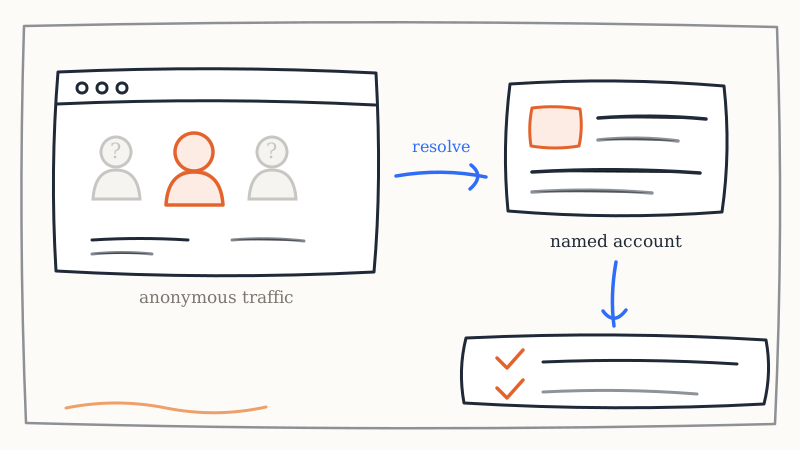
Somewhere between 95 and 98 percent of the companies that visit a B2B website leave without filling in anything. They read the pricing page, they compare two of your product pages, they send the link to a colleague, and then they vanish. Your analytics records a session. Your CRM records nothing. Your SDR team, meanwhile, is cold-calling a list bought three months ago.
That gap is the most expensive thing in most GTM stacks. The accounts already researching you are, by definition, the warmest accounts you will touch this quarter, and almost all of them stay anonymous by default. Website visitor identification is the practice of closing that gap.
At GroomLead we engineer outbound systems on a pay-per-lead basis, which means we only get paid when a signal becomes a real conversation. That incentive makes us ruthless about which signals are worth acting on. Visitor data is one of the strongest available, and also one of the most commonly misread. This guide covers both halves.
Short answer
Website visitor identification is the process of resolving anonymous website traffic into named companies (and sometimes named people) so your team can follow up without waiting for a form fill. In B2B it works mainly at the account level, by matching a visitor’s IP address and device signals against a database of company network footprints. Person-level identification is possible but far narrower in scope and much more legally constrained.
Done well, it adds a fresh, high-intent tier to your outbound list. Done badly, it produces a firehose of noise: ISP traffic, your own employees, bots, and job applicants reading your careers page. The difference is entirely in the scoring and the follow-up play, not in the vendor you pick.
What visitor identification actually resolves
There are two distinct things people mean by the phrase, and conflating them is how teams end up disappointed.
Account-level (company) identification. The system determines that someone at Acme Corp visited. This is the reliable, widely usable version. Match rates on B2B traffic typically land somewhere in the 30 to 55 percent range for companies with their own network infrastructure, and far lower for small businesses and remote workers on residential connections.
Person-level identification. The system claims to tell you which individual visited. This relies on identity graphs built from cookie syncs, email opens, and prior form fills. Coverage is thin, accuracy degrades quickly, and in most jurisdictions it carries real compliance exposure. Treat any vendor promising high person-level match rates with suspicion.
The practical takeaway: build your play around knowing the account, then use your own data to choose who to contact inside it. That ordering is both more accurate and far easier to defend.
How the identification works
Four mechanisms do nearly all of the work, usually layered.
| Mechanism | What it resolves | Reliability |
|---|---|---|
| Reverse IP lookup | Company, from a corporate network IP | Good for mid-market and enterprise, weak for remote and SMB |
| First-party de-anonymization | Returning visitor, via your own cookie set after a prior form fill or email click | High accuracy, limited to people you already know |
| Email click-through stitching | Links a sequence recipient to a later session | High accuracy, only covers accounts already in sequence |
| Identity graph matching | Individual, via third-party cookie or hashed email sync | Low coverage, declining fast, highest compliance risk |
Two things follow from that table. First, the single highest-accuracy signal available to you is first-party: a known contact clicking an email and then browsing. That costs nothing and needs no vendor. Second, reverse IP has a structural blind spot in remote work, which is why your match rate will never approach 100 percent and should not be expected to.
Not every visit is intent
This is where most programs fail. A visit is an event, not an intent signal. The job is to separate the two, and the only way to do that is to score visits on four dimensions.
Page tier. Not all pages carry the same weight. Build an explicit tier list.
- Tier 1 (high intent): pricing, demo request, product comparison, integration pages, security and compliance documentation
- Tier 2 (researching): specific product or feature pages, case studies, ROI calculators
- Tier 3 (ambient): blog posts, glossary pages, careers, press
- Tier 0 (suppress): careers, support and documentation login, your own office IPs, existing-customer accounts
A single pricing-page visit beats eleven blog visits. Treat them accordingly.
Depth. One page is a bounce. Four or more pages in a session is a research task. Depth is the cheapest, most honest proxy for seriousness you have.
Frequency and spread. The strongest pattern in all of visitor data is not one person reading a lot. It is three different people from the same company in the same week. That is a buying committee forming, and it is a far better trigger than any individual session. If your tooling can show you account-level visit counts rising week over week, that curve is your highest-value alert.
Recency. Website intent decays in hours, not weeks. A pricing-page visit acted on the same day is a different asset than the same visit surfaced in a Monday report. This is the entire reason visitor identification programs live or die on response speed, covered below.
Scoring in practice
A workable first-pass model, deliberately simple:
| Behavior | Points |
|---|---|
| Tier 1 page view | 25 |
| Tier 2 page view | 10 |
| Tier 3 page view | 2 |
| Third or later session in 7 days | 20 |
| Second distinct visitor from the account in 7 days | 25 |
| Session depth of 4 or more pages | 15 |
| Matches your ICP firmographics | 20 |
| Does not match ICP | Suppress entirely |
Set an action threshold (start around 50) and a decay rule (halve the score every 72 hours). Resist adding more factors until the simple version has run for a month. Elaborate scoring models built before you have any outcome data are just guesses with arithmetic on top.
The ICP suppression line matters more than any of the point values. An unscored visitor feed will happily route your reps to agencies, students, competitors, and vendors. Gate the feed on your ideal customer profile before it ever reaches a rep.
The play: from page view to booked meeting
A signal with no attached workflow is trivia. Here is the sequence that converts.
1. Route on the same day. Website intent decaying in hours means a daily digest is already too slow for Tier 1 hits. Pricing-page visits from ICP accounts should reach an owner within the hour. Everything else can batch daily.
2. Pick the person, not the visitor. You know the account, not reliably the individual. So choose the contact deliberately: the role that owns the problem your Tier 1 page describes. If three people from the account visited, that is a committee signal and the right response is to multithread rather than to guess at a single champion.
3. Reference the behavior obliquely, never explicitly. This is the rule that separates a program that works from one that creeps people out. Never write “I saw you were looking at our pricing page.” It is unsettling and it invites a privacy complaint. Instead, let the signal choose the topic and write a normal email about that topic. If they were deep in your integrations documentation, open about the integration. The signal informs the angle; the angle does the selling.
4. Stack it with other signals. Visitor data is strongest in combination. An account that visited your pricing page and just hired a VP of Revenue and has a competitor contract coming up is a different proposition from any one of those alone. Watching those streams continuously is the job of CAM, which turns buying signals (job changes, social listening, competitor connections, and website activity) into lead lists, so the account arrives already assembled rather than needing a manual stitch across four tabs.
5. Be ready for the reply. A same-day trigger email sent to a genuinely warm account gets replies, often within minutes, and often outside the hours your reps are watching. A reply that sits unanswered until tomorrow wastes the entire signal, which is the whole argument behind a five-minute response standard. This is where Underfive.ai does the work: a unified inbox across every sending account, with AI inbox agents that label replies, draft responses in under five minutes, and book the meeting before the intent decays.
Visitor identification compared to other intent signals
| Signal | Freshness | Coverage | Precision |
|---|---|---|---|
| Website visit (Tier 1) | Hours | Only accounts already aware of you | High |
| Job change trigger | Weeks | Broad | Medium to high |
| Competitor contract signal | Weeks | Narrow | High |
| Third-party intent topic data | Days to weeks | Broad | Low to medium |
| Hiring surge | Weeks | Broad | Medium |
The pattern worth noticing: visitor identification has the best freshness and precision but the worst coverage, because it can only ever surface accounts that already found you. That makes it a multiplier on demand you have already generated, not a source of new reach. Teams that expect it to fill a pipeline from zero are using the wrong tool. Teams that use it to make sure no already-interested account goes untouched are using it correctly.
Compliance, briefly and seriously
Account-level identification from IP data is generally defensible: you are identifying an organization, not a person. Person-level identification is a different legal object, and in GDPR jurisdictions it is personal data processing that needs a lawful basis.
Practical guardrails:
- Disclose visitor analytics in your privacy policy, in plain language
- Honor consent signals and do not route identified visits from users who declined tracking
- Do not quote browsing behavior back to prospects in outreach
- Keep retention short, because a 90-day-old page view has no operational value anyway
- Apply stricter handling to EU and UK traffic than to US traffic, rather than one loose global default
None of this is a reason to skip the program. It is a reason to run the account-level version well instead of buying the person-level version carelessly.
Common mistakes
Treating the feed as a lead list. Identified visitors are accounts to prioritize, not contacts to blast. The feed replaces your prioritization logic, not your targeting logic.
No suppression list. Without excluding your own staff, current customers, competitors, agencies, and job seekers, somewhere around half the feed is noise, and reps stop trusting it within two weeks. Trust lost this way is very hard to win back.
Daily digests for hot signals. A report is a reporting tool. Tier 1 intent needs an alert with a named owner attached.
Measuring the wrong thing. Match rate is a vendor metric. The metrics that matter are meetings booked from identified accounts, and the lift in reply rate versus your cold baseline. Fold those into the same dashboard as your other outbound KPIs instead of letting the vendor’s console define success.
Creepy copy. Covered above, and worth repeating, because a single “I noticed you visiting” email can cost more in brand damage than the program earns in a month.
A 30-day start
- Week 1: Tier your pages. Build the suppression list. Confirm your privacy policy covers visitor analytics.
- Week 2: Turn on account-level identification. Watch the raw feed without acting on it, and measure how much survives ICP filtering. If less than a third survives, fix targeting before building workflow.
- Week 3: Implement the simple score. Route Tier 1 same-day to a named owner, everything else into a daily batch. Write two trigger email templates: one for pricing-page intent, one for integration or documentation intent.
- Week 4: Measure reply rate on triggered outreach against your cold baseline. If the lift is not at least 2x, the problem is almost always the copy referencing the signal too directly, or the routing being too slow.
Frequently asked questions
What percentage of website visitors can you actually identify? At the account level, expect roughly 30 to 55 percent of B2B traffic, heavily dependent on your audience. Enterprise-heavy traffic resolves well, SMB and remote-worker traffic resolves poorly. Treat any claim above that range as a definitional trick.
Is website visitor identification legal? Account-level identification from IP data is broadly defensible because it identifies an organization rather than an individual. Person-level identification is personal data processing and needs a lawful basis under GDPR, plus disclosure and consent handling. Disclose it, honor consent, and keep retention short.
Should I mention that I saw them on our website? No. Let the visit choose the topic of your outreach and write a normal email about that topic. Explicit references to browsing behavior read as surveillance and generate complaints.
How quickly does website intent decay? Hours for high-intent pages. A pricing-page visit acted on within the hour performs very differently from the same visit worked three days later. Build routing around that, not around reporting convenience.
Is it better than third-party intent data? It is more precise and much fresher, but covers only accounts that already found you. The two are complements: third-party data for reach, visitor identification for prioritizing accounts already in motion.
What is the single strongest pattern in visitor data? Multiple distinct people from one account visiting in the same week. That is a buying committee forming, and it outperforms any individual session as a trigger.
The takeaway
Website visitor identification is not a prospecting channel. It is a prioritization layer that makes sure the accounts already evaluating you never sit untouched while your reps dial a stale list. The technology half is straightforward and largely commoditized. The half that decides whether it works is the unglamorous part: tier your pages, suppress aggressively, gate on ICP, route within the hour, write copy that never mentions the signal, and answer the reply fast.
If you would rather have that layer engineered and running than spend a quarter assembling it, GroomLead builds outbound systems on a pay-per-lead model, with no retainers and no ramp time. Book a call and we will map which of your anonymous traffic is worth chasing.
Ready to engineer your own GTM system?
GroomLead engineers outbound systems for B2B teams, and builds the tools inside this post.
Book Strategy Call